
Tournaments
What you are choosing between
Every tournament is one game, one entry level, one format and one currency. Those four choices are the whole menu — everything else is how well you play.
One — the entry level
Five rungs, and the fee falls as you climb
The platform fee is a percentage of the entry pool. Everything left is the prize, split down the finishing order.
Free
No entry fee
Real tournaments, house-funded prize, no entry fee. This is where you find out whether you like it.
Bronze
14% platform fee
The first paid rung, and the widest. Small entries, the largest groups, and bonus balance is accepted here.
Silver
11% platform fee
For players who have stopped losing to the clock. Bigger pools, tighter fields.
Gold
8% platform fee
Serious entries against players whose ratings say they belong there.
Platinum
6% platform fee
The top of the ladder, and the lowest fee on the platform.
Every paid level also runs a Light variant at about half the entry, on the same fee — so you can step up gradually instead of doubling your entry to move a rung.
Bonus balance is accepted on Free and Bronze only. A welcome or referral credit gets you into real tournaments; it does not buy a seat at the top of the ladder.
The exact entry fee, the exact fee we take and the exact prize are all on the tournament screen in your own currency, before you confirm anything. This page quotes no figures on purpose — they are set per currency and they move.
Two — the format
A field that fills, or a window that is open
A small field that fills, plays together, and settles.
- You are matched into a group of players in your skill band, then everyone starts at once.
- If the group does not reach its minimum by the fill deadline, it is cancelled and every entry is refunded.
- The prize pool is exactly the entries paid in, less the platform fee, split down the finishing order.
Suits: Short sittings, and knowing exactly who you beat.
An open window. Join any time it is live, no waiting for a group to fill.
- One shared board for everyone who enters the window — no fill wait and no minimum.
- Your best qualifying run stands. Come back and improve it before the window closes.
- When the window closes the pool is split across the top finishers.
Suits: Playing on your own schedule, and chasing a number you can see.
- An underfilled group is cancelled and refunded. If a group has not reached its minimum when the fill window closes, nobody plays and every entry goes back — you are never left in a two-player tournament you paid a four-player entry for.
- A tie goes to the earlier score. The run set first wins, because it was set with less information about what it needed to beat.
Three — who you play
Take the matchmaker, or pick your own field
Quick join
Tap once and the matchmaker puts you in an open group.
It prefers a group of players in your skill band and falls back to any open group rather than leaving you waiting — so a join is never blocked because the band was thin.
Host a public group
Open your own table and let anyone fill it.
You choose the size, up to the cap for that entry level, and you can start early once enough players have joined instead of waiting out the fill timer.
Host a private group
Invite-only. Share a six-character code and play just your people.
A private group is kept out of matchmaking and out of every public listing. The code is the only way in, so the field is exactly who you invited — same entry, same board, same payout rules.
How hosting a private group actually goes
Pick the game and the entry level, choose how many seats, and the app gives you a six-character code. Send it however you like. Anyone with the code lands in your group — not a copy of it — and the group starts when you start it or when it fills, whichever comes first.
The entry, the board, the fee and the payout rules are identical to a public group at the same level. Hosting changes who is in the room, and nothing else.
On screen
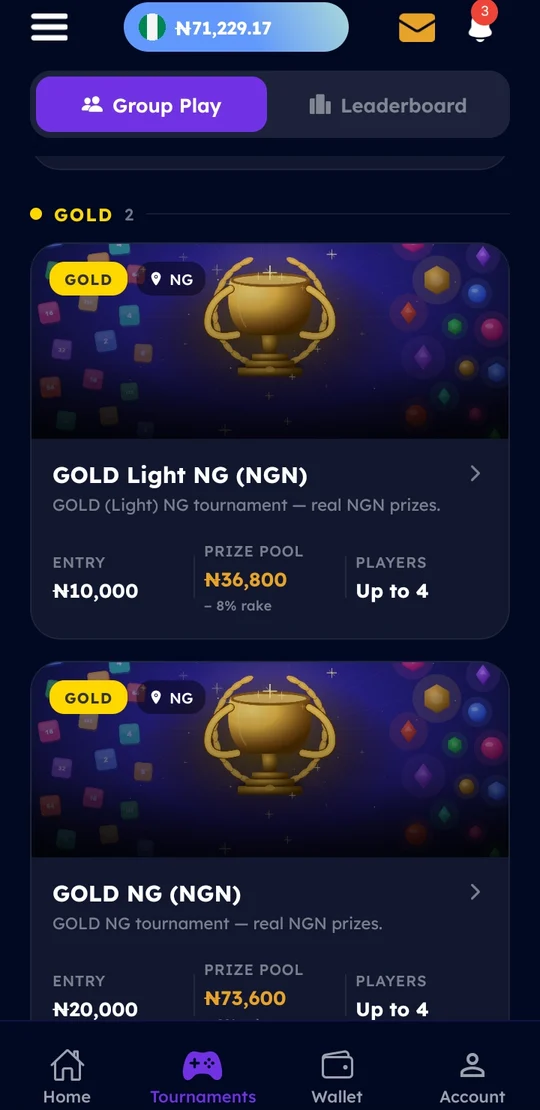
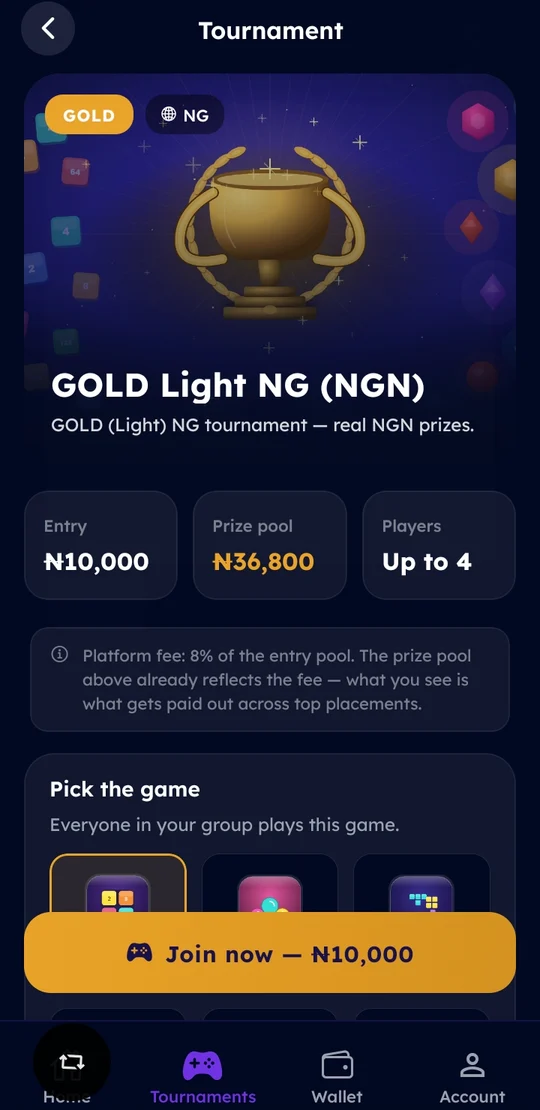
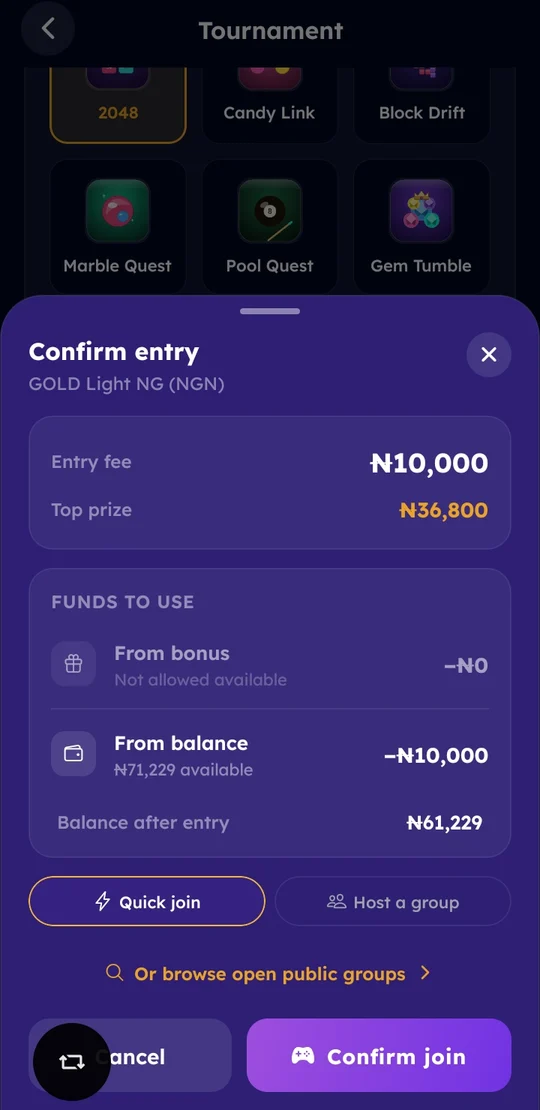
The same three steps, as the app shows them
Real screens from the current build — the list, one tournament in full, and the confirmation you see before anything leaves your wallet.
Four — the currency
Local money for local tournaments, one pool for Global ones
Your account gets a wallet in your country’s currency. Local tournaments run in local money against players in your country. Global tournaments put Nigeria and Ghana in one prize pool: priced in US dollars, and paid for and won in your own currency at the rate shown when you join.
Which local wallet you get is decided by your account’s country when you sign up, not by where your phone happens to be. Moving country is a support request, so a trip abroad never changes what you hold or what you can enter.